

Hi! I’m a passionate speaker, educator, and advocate for both nonfiction writing and small press publishing. Get a woman who can do both! Experimental nonfiction is my stronghold, and I will likely be the most animated presenter on the strengths and opportunities of both writing and reading in the porous “nonfiction” genre that your organization has ever seen. I’ve been writing, submitting, and publishing my nonfiction work since 2012, and my core modes are the erasure essay, the speculative essay, the visual essay, and the constraint essay.
But! I’m also the director of Split/Lip Press, a small press dedicated to publishing boundary-breaking prose. I’ve worked within the literary community in various roles (reader for literary journals, nonfiction editor for a small press, director for a small press) since 2017.
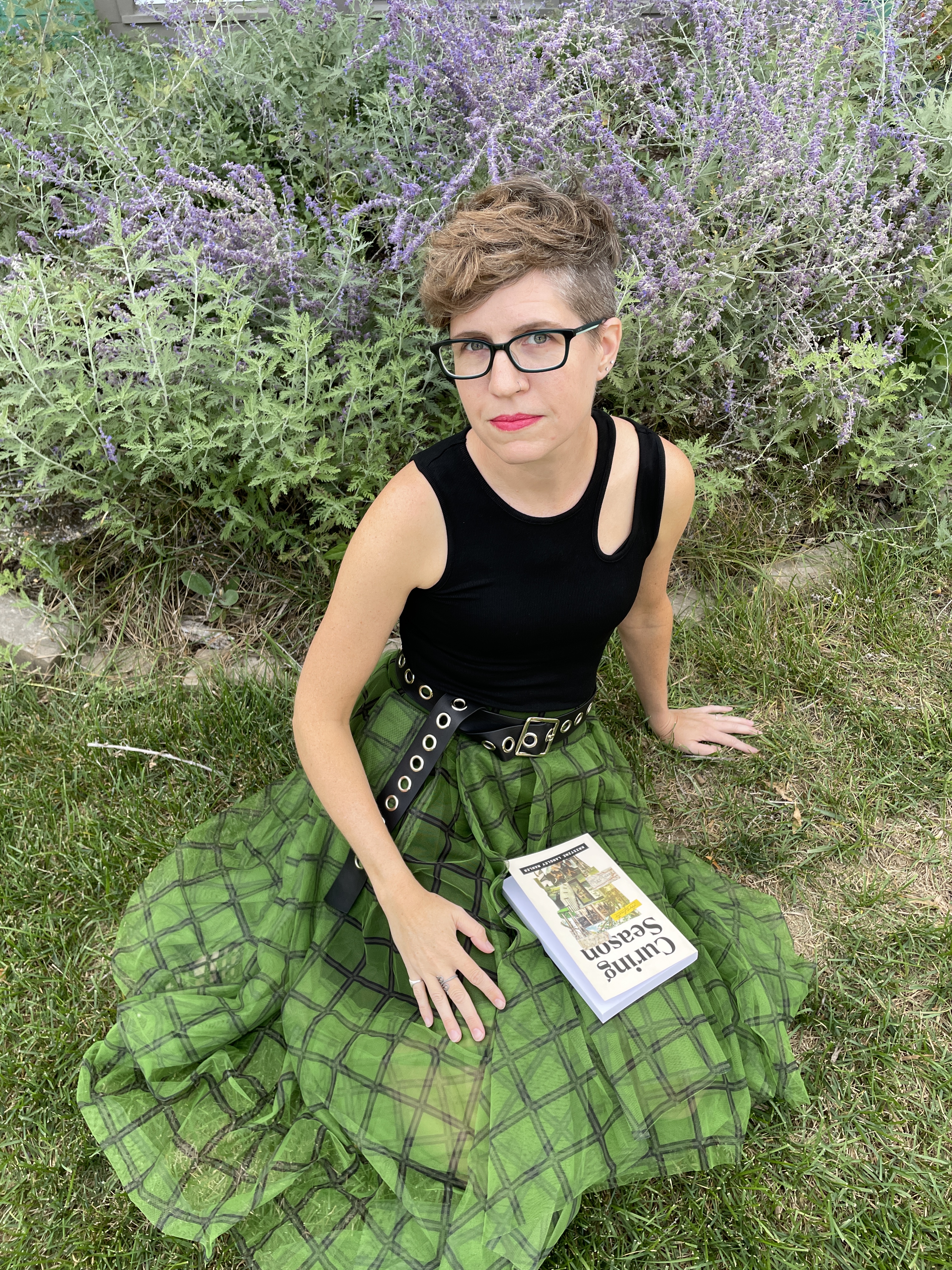
I love demystifying the process of small press publishing, both from an insider’s perspective as the director of a small press since 2020, and as a small press author myself who’s published books with both a university press (Curing Season: Artifacts, West Virginia University Press, 2022) and an independent small press (A Calendar Is a Snakeskin, Autofocus Books, 2023, and Teen Queen Training, Autofocus Books, 2026).
I’m happy to Zoom into classrooms for one-off presentations and conversations; I’m also available to travel for longer engagements. I’m located in Omaha, Nebraska and as a Midwesterner, it’s in my upbringing to drive 6hrs one-way without flinching. Located further away? I’m happy to fly, as long as you’re covering my ticket.
I’m an experienced nonfiction awards judge, and I’m an expedient, thorough, and comprehensive reviewer for memoir/essay collection book manuscripts under consideration at small presses.

Past clients and collaborators include: Kearney Public Library; Sacred Heart University; Rutgers University; Hastings College; Marian High School; The Good Life Review; Write or Die Workshops; Oklahoma State University; Wilfred Laurier University Press; the Wisconsin Writers Awards; the Omaha Public Library; Sweet Briar College; the University of Baltimore; Bridgewater State University; Writing Workshops Dallas; the University of Arizona; the Lafayette Writers’ Studio; Bouteloua LitART Fest; the University of North Dakota Virtual Speaker Series in Writing, Publishing, and Editing; the University of Nebraska-Omaha; and Washington State University.
I’d love to discuss what you’ve got in mind—and how we can
work together!
Sample Workshops/Lectures I’ve taught and previously given:
The Erasure Essay Workshop: Condensed (workshop, 1hr)
A concentrated introduction to erasure essays through a mini-lecture, brief readings followed by discussion, and concluding with a guided workshop to practice developing an erasure essay.
All Prompts, ALL THE TIME (workshop, 2hrs)
You’re here to write, I’m here to give you four mini craft-talks on experimental nonfiction and guide you through eight different prompts over the next two hours. I’ll keep you on track, barking prompts at you approximately every ten minutes. We’ll take a finger-stretch break halfway through, and when the class is over and you have carpal tunnel, you’ll also have EIGHT ESSAY STARTS. That you did! You did them! Good for you!
Writing the Experimental Essay (workshop, 4 classes, 1.5hr/each)
The essay is arguably the most elastic form of literature, at times allowing journalism, personal recollection, biography, and current events to coexist in a single space.
But the essay needs containers to hold its matter which are as bendable and movable as its wide-ranging subjects. We will explore four modes of experimenting with essay structure: The Speculative Essay (the real + the unreal), The Erasure Essay (creating yours from theirs), The Visual Essay (image + text), and The Constraint Essay (form-dependent/hermit crab).
Through discussion, readings, and take-home exercises, writers will stretch their own limits and explore new frontiers in nonfiction, finding that the methods to examine truth and facts are endless.
Artifacts into Art: Nonfiction Excavation (workshop, 2hrs)
The artifacts we collect have been saved because they have unique, distinct meanings specific to our own experiences. The feathers, the mixtapes, the framed photos, the clothes. Sometimes we display our artifacts; sometimes we keep them hidden away in boxes, content to simply know we possess them. The metaphor writes itself: artifacts are a natural complement to our writing practice! Artifacts as inspiration, artifacts as tools, artifacts as the instruments of destruction. We will read essays which use artifacts in their construction, we will practice writing essays which lean on artifacts as evidence to corroborate our truth, and we will learn how to turn written artifacts (our own or others’) into erasure essays. Through readings, discussion, in-class assignments, and take-home prompts, writers will appreciate the value of their artifacts anew. This class is geared toward all levels and to nonfiction writers in particular, but the practices can be easily adapted for fiction and poetry writers.
From the Submission Queue to Publication Day (and Beyond): Inside Split/Lip Press (lecture, 1hr)
Ever wonder what REALLY happens on the back end when you submit your book to a small press? Demystifying the process and illuminating opportunities, this lecture explains how a book moves from its submission to the reading queue to acceptance and contract, how the editorial process and marketing plans are carried out, and what publication looks like, on the official pub day and beyond, by explaining the procedures at one independent small press (Split/Lip Press). If you’re only familiar with the Big 5 and agenting, this lecture will open a lot of doors to show the other opportunities available for books in the small press publishing world!
On the Inquiry for Truth as a Civic Good (lecture, 1hr)
The search for truth is at the heart of creative nonfiction: what is fact, what is fiction, and how do we reconcile the lines we may have intentionally blurred for our own self-preservation? Nonfiction must always be true, and yet it can never fully be true because emotion frequently overrides a writer’s actual experience to create the truth that remains: a moment the writer decides to call true because it is true to how they remember it.
So much “history” has been recorded into “truths” which traditionally fit the needs of those who controlled it—primarily white people—and the codified forms of these records have been weaponized to suppress alternate threads of fact. When writing creative nonfiction, acknowledging one’s filtered history and placing it alongside recorded history, in tandem with the admittance of concurrent (and often unvoiced or ignored) histories, permits a richer and fuller perspective. We come to know both ourselves and our society better through the reconsideration of facts once presumed to be settled.
Discussing the theoretical constructs of nonfiction and using examples from her two nonfiction books, Curing Season and A Calendar Is a Snakeskin, Kristine Langley Mahler will speak about her own search for truth as both a civic good and as a form of self-inquiry and forgiveness.

